Website Designing & Development
Fast, mobile-first websites that give your ad clicks somewhere good to land. Starts at ₹8,000, delivered in 3 days.
Learn MoreWebVengers is a performance-focused Google Ads agency. Our Google Ads services cover Search, Performance Max, Sales, Shopping, App and YouTube campaigns, run by a Google Ads expert with several years of hands-on experience. Management starts at ₹7,000 per month, and your ad money goes straight to Google. Our paid advertising services also include Meta Ads, SEO and landing pages.
Get a Free Google Ads Audit
From one real Search + Performance Max account. Every business is different, so your results will be your own.
Businesses that chose WebVengers to grow online.




A Google Ads agency is a team that plans, builds and manages paid campaigns on Google so your business appears when people search for what you sell. It handles keyword research, ad copy, conversion tracking, bidding, budgets and reporting. You pay Google for the clicks, and you pay the agency for the work that turns those clicks into enquiries and sales.
That last sentence matters more than it sounds. Anyone can buy clicks. What separates a serious Google Ads agency from a casual one is whether the clicks are the right clicks, whether somebody is measuring what happens after them, and whether the campaign gets better every month instead of simply getting more expensive.
At WebVengers, our Google Ads services are designed around that idea. We start with your business numbers, build the campaign around real search intent, track every enquiry we can, and report on leads and revenue rather than vanity metrics.
Open Google on any phone in India and watch what happens. Someone in Jaipur types “best dentist near me”. Someone in Pune searches “office chairs wholesale”. A parent in Lucknow looks up “IELTS coaching fees”. Within a second, a handful of businesses appear at the top with an ad label, and those businesses get the first chance at the click. That small moment, repeated millions of times a day, is exactly what a Google Ads agency exists to win for you.
WebVengers is a Meerut-based Google Ads agency that works with businesses across the country. We have been running Google Ads campaigns for several years, and our work covers local service providers, clinics, real estate, education, e-commerce stores, manufacturers and B2B companies. Our Google Ads services, and the wider paid advertising services around them, are built around one plain question: if you put ₹1 into this campaign, what comes back?
Plenty of agencies can open an account and switch on a few keywords. The harder part is everything around it: choosing the right campaign type, keeping junk searches out, matching every ad to a page that makes sense, tracking enquiries properly, and then having the patience to improve a campaign week after week. That is the part we care about, and it is why a hands-on Google Ads expert is worth far more than a copy-paste setup.
A campaign that performs well in Delhi NCR can struggle in Indore, and a strategy that works for a Mumbai clinic may be wrong for a clinic in Lucknow. Languages, device habits, buying power, competition and even the time of day people search all change from one region to the next. Pan-India does not mean “turn on the whole country and hope”. It means building each location group around how those customers actually behave.
When you work with us, the person planning your campaign is the person improving it. You get straight answers about what is working, what is wasting money and what we plan to change next. If Google Ads is not the right channel for your goal, we will say so before you spend a rupee.
Google Ads works hardest when the website, search visibility and other ad channels around it are strong too. Here is everything WebVengers offers.
Fast, mobile-first websites that give your ad clicks somewhere good to land. Starts at ₹8,000, delivered in 3 days.
Learn MoreOne page, one offer, built to match your ad. Starts at ₹2,000, delivered in 1 day.
Learn MoreOn-page, local and AI-search-ready SEO that keeps bringing visitors long after the ad budget ends.
Learn MoreSearch, Performance Max, Shopping, App and YouTube campaigns, managed for enquiries and sales.
Learn MoreFacebook and Instagram campaigns that create demand before people even start searching.
Learn MoreOne plan that joins your website, search and paid ads, so every channel pulls in the same direction.
Learn MoreOur Google Ads services, and the paid advertising services that support them, cover the whole journey, from the first audit to the monthly report you can actually read.
We review your existing account or your business model, look at competitors and search demand, and build a plan before spending. If an account already exists, we find where money is leaking.
Keyword research, match types, negative keywords, ad copy testing and search-term reviews, so your budget goes to people who are ready to act.
Asset groups, audience signals and goal setup for campaigns that run across Google, backed by conversion data that tells the system what a good result is.
Merchant Center setup, product title and feed clean-up, and campaign structure that puts your best sellers in front of buyers.
Creative direction, audience targeting and conversion tracking for apps and video, with clear goals so spend does not drift into empty views.
Calls, forms, WhatsApp clicks, purchases and bookings tracked properly, so every decision after launch is based on evidence.
We tell you what is hurting conversions on your page and, when needed, build a fast landing page or website that matches the ad.
Follow-up ads for people who visited but did not enquire, kept sensible so you do not chase the same person for months.
Plain monthly reports covering spend, enquiries, cost per enquiry and what we will change next, with no maze of dashboards.
Google gives you several ways to spend money, and each one suits a different goal. Here is what each campaign type does, who it is for and how our Google Ads expert team handles it.
Search campaigns show text ads on Google results when someone types a query that matches your keywords. It is the closest thing digital marketing has to catching a customer with their hand already up, which is why most of our client accounts begin here.
The strength of Search is intent. A person typing “CA for GST filing in Indore” or “bulk steel supplier Raipur” is not browsing for fun. They have a problem and are looking for someone to solve it. A good campaign puts your business in front of that person with a message that matches the problem, then sends them to a page built for that exact query.
We build tightly grouped keyword themes instead of dumping hundreds of terms in one bucket. Match types are chosen deliberately, negative keywords are added from day one, and ad copy is written to answer the searcher, not to brag. After launch, the search terms report becomes our daily map: it shows what people really typed before clicking, which lets us add the winners and block the time-wasters. We also watch Quality Score signals such as expected click-through rate, ad relevance and landing page experience, because they directly influence how much you pay per click.
Search is also where location targeting pays off the most. A one-city business should not pay for clicks from five states away, and a national seller should group regions by performance instead of treating the map as a single block.
Performance Max, usually called PMax, is a goal-based campaign type that uses Google’s automation to serve your ads across Search, YouTube, Display, Discover, Gmail and Maps from a single campaign. You provide the goal, the budget and the creative assets, and the system looks for people most likely to convert.
That sounds like a shortcut, and that is exactly where businesses get into trouble. PMax is only as smart as the information you feed it. If conversion tracking counts every page view as a “lead”, the campaign will happily chase page views. If your assets are weak, the ads will be weak everywhere at once. We have seen accounts where a badly set up Performance Max campaign quietly ate most of the budget with very little to show for it.
We treat PMax as a second step, not a first step. Once a Search campaign or an existing account has proven which conversions matter, we build asset groups around real products and services, add audience signals from your actual customers, and set conversion goals that reflect real value. We keep a close eye on where the spend lands, add brand and negative controls where possible, and compare PMax against Search so you know whether it is adding new customers or simply repeating what Search already earned.
In one of our live accounts, Search and Performance Max working together produced thousands of conversions at a steady cost per conversion. The lesson was not that PMax is magic. It was that the combination, with clean tracking behind it, can scale far better than either one alone.
When you create a campaign in Google Ads, the first decision is the goal, and “Sales” is the one for businesses that want people to buy. A sales-goal campaign can drive purchases on your website, inside your app, over the phone or in a physical store, and it can use several campaign types underneath, including Search, Performance Max, Shopping, Display and video.
The reason this matters is that Google optimises towards the goal you choose. Pick “Website traffic” and the system hunts for clicks. Pick “Sales” with proper purchase tracking and it starts hunting for buyers. In our experience, the same product page can perform very differently depending on whether the goal was set honestly.
We begin with purchase tracking that records real order values, so the bidding system learns the difference between a ₹499 order and a ₹14,999 one. We then match campaign types to your catalogue size and margins, set targets based on what a sale is actually worth after costs, and look closely at the full path: product page speed, price clarity, delivery information, reviews and checkout friction. Ads cannot rescue a checkout that frustrates people, so we flag those problems early and, if you want, fix them through our website development team.
For businesses that sell by phone or WhatsApp rather than a cart, we set up call and chat conversions and import offline results where possible, so “sales” reflects real closed deals.
Shopping ads display your product image, title, price and store name directly in Google results, so shoppers can compare before they even click. They are powered by a product feed in Google Merchant Center rather than keywords you write by hand, which makes the quality of that feed the most important part of the campaign.
A weak feed leaks money in quiet ways. A title like “Men’s T-Shirt” competes with thousands of identical listings, while “Men’s Cotton Round Neck T-Shirt, Navy Blue, Size M” matches how people really search. Missing images, wrong prices, out-of-stock products and poor categories all reduce reach or waste budget.
We audit the feed first: titles, descriptions, product types, images, identifiers, availability and price accuracy. Then we structure campaigns around margin and performance instead of throwing every product into one pot, giving hero products their own space and keeping slow movers on a lean budget. Search terms are reviewed to block irrelevant queries, and we compare standard Shopping with Performance Max using your feed to see which combination gives better return for your catalogue.
Shopping rewards patience and clean data. When both are in place, it is often one of the most efficient ways for a product business to meet buyers who are already comparing options.
App campaigns promote your mobile app across Google Search, Google Play, YouTube and the Display network from one setup. You supply text, images and video, and Google assembles ads in different formats and places them where they are likely to bring installs or in-app actions.
The biggest mistake in app marketing is celebrating installs. An install that never opens the app is just a cost. A user who registers, completes a first booking or makes a first purchase is the one that matters. That is why the optimisation target, and the events behind it, decide whether the campaign works.
We start by setting up in-app event tracking through Firebase or your app measurement partner, so the campaign can learn from actions such as sign-ups, first orders or subscriptions. We begin by optimising for installs to gather data, then move towards in-app actions once there is enough volume. Creative refreshes are planned in advance, because app campaigns need a steady supply of fresh text, visuals and video to stay effective. We also compare cost per install against cost per registered or paying user, which is the number that really tells you whether the channel is healthy.
If your app is new, we help you structure the first test with a modest budget and a clear success rule, so you can decide whether to scale without guessing.
YouTube is one of the most-watched platforms in India, and video lets you do what a text ad cannot: show your product working, introduce the people behind the business or walk a buyer through a project. YouTube campaigns place your video ads in front of chosen audiences in formats such as skippable in-stream, in-feed and Shorts placements.
Because video can be used for awareness, consideration or direct response, the first job is picking the goal honestly. A reach campaign and a lead campaign are not the same thing, and measuring them with the same yardstick causes confusion. Billing also depends on the format and goal, for example cost per view or cost per thousand impressions, so we set expectations before the first rupee is spent.
We plan the first five seconds of the video as carefully as the rest, since that is where viewers decide to stay or skip. We target by custom segments built from search behaviour, interests, remarketing lists and relevant placements, then compare view rates, engaged views and downstream conversions. When video supports a Search campaign, we also check whether branded searches rise afterwards, which is a healthy sign the video is doing its job.
YouTube works best as part of a sequence: video builds familiarity, remarketing brings viewers back, and Search captures them when they are ready. We design the campaigns so that sequence actually connects.
Display campaigns show banner and responsive ads across millions of websites and apps in Google’s network. The intent is lower than Search, so Display is rarely the first campaign we recommend, but it is excellent for remarketing, where you reach people who already visited your website and did not enquire.
Remarketing works because most buyers do not decide on the first visit. A person may compare three clinics, check prices, ask a friend and come back a week later. A gentle reminder in that window can be the difference between you and the competitor they visited second. We cap frequency and exclude people who already converted, so the ads stay helpful rather than annoying.
Demand Gen is the visual campaign type that replaced Discovery campaigns, serving image and video ads across YouTube, Discover and Gmail. It suits brands with strong creative that want to spark interest in people who are not searching yet. We test it in a controlled way, with its own budget and its own measurement, so it never hides inside overall account numbers.
Pay per click advertising (PPC) is a model where you pay a platform only when someone clicks your ad. Google Ads is the biggest PPC platform in the world. Instead of paying for space like a hoarding, you bid for the chance to appear when a person searches for something, and you are charged when they actually visit your page.
If you have ever wondered why two businesses selling the same thing pay very different amounts for the same click, the answer sits inside how pay per click advertising works. It is not a flat price list. It is a live auction that runs every time somebody searches, and understanding it makes you a far better buyer of any Google Ads services.
Each time a search happens, Google looks at the advertisers whose keywords match and decides, in a fraction of a second, whether to show ads and in what order. Your position is decided by what is commonly called Ad Rank, which combines your bid, the quality of your ad and landing page, the expected impact of your ad assets and the context of the search. The important takeaway is that the highest bidder does not automatically win. A relevant ad with a good page can beat a bigger bid, and often pays less per click while doing it.
Quality Score is Google’s one-to-ten estimate of how relevant and useful your keyword, ad and landing page are to the person searching. It is built from expected click-through rate, ad relevance and landing page experience. You cannot buy a better score. You can only earn it by making the whole journey sensible, and the reward is real: better positions at lower cost.
The amount you pay when someone clicks your ad. It changes by keyword, competition, location and time.
What you pay for each enquiry, booking or sale. This is the number that decides whether a campaign is healthy.
The share of clicks that turn into an action such as a call, form or purchase. Page quality moves this number more than most people expect.
Revenue generated for every rupee spent on ads. A useful measure for businesses that can attach a value to each sale.
You set an average daily budget, and Google may spend up to double that amount on a single high-opportunity day. Across the month, however, you will not be charged more than your daily budget multiplied by the average number of days in a month. This means a quiet day can be balanced by a busy one, and it is another reason we judge campaigns over weeks instead of hours.
Modern pay per click advertising leans heavily on automated bidding strategies such as Maximise Conversions, Target CPA and Target ROAS. They use signals like device, location, time of day and search context to set a bid for every individual auction. Done well, this saves enormous effort. Done carelessly, it optimises towards the wrong goal. A Google Ads expert earns their fee by feeding the system accurate conversion data, choosing the right strategy for the stage of the account and knowing when to let it learn and when to intervene.
A ₹6 click that never turns into a customer is more expensive than a ₹60 click that does. We care about cost per enquiry and cost per sale, not cost per click alone. This is also why we are happy to bid higher on searches that show clear buying intent and spend less, or nothing, on curiosity searches that bring traffic without business. Our website development and landing page work exists partly for this reason: when the page converts better, every click you pay for is worth more.
Our paid advertising services work together, but each channel does a different job. Use this table as a starting point.
| Channel | Customer mindset | Speed to results | Best for | Watch out for |
|---|---|---|---|---|
| Google Ads | Searching right now and ready to compare or buy | Days to weeks, once tracking is live | Local services, clinics, B2B, e-commerce, high-intent leads | Paying for clicks that never convert if the page or offer is weak |
| Meta Ads | Scrolling, not yet searching, open to discovering something new | Days to weeks, creative testing needed | Offers, new openings, visual products, building demand | Lower intent, so lead quality needs close monitoring |
| SEO | Searching, and trusts organic results | Months, then compounds over time | Long-term visibility, content, local presence | Patience required, and no click is guaranteed on day one |
| YouTube Ads | Watching or learning, often before a purchase decision | Awareness first, conversions follow | Brand trust, demos, education-led products | Measuring video by clicks alone gives a misleading picture |
Most businesses do not need every channel on day one. A sensible order for many local and service businesses is: get the website or landing page right, start with Google Search because intent is highest, add remarketing to catch people who leave, and then layer in Meta Ads to create demand and SEO to build the asset that keeps working when the budget is paused.
Choosing between channels is really a question of timing and budget. If you need enquiries this month, paid search is the fastest route. If you want to be the business people find next year without paying per click, SEO deserves a share of attention now. We will tell you honestly how we would split your budget, even if the honest answer is to start small and prove one channel first.
Two costs are always involved in Google Ads, and mixing them up is the most common source of confusion. Here is how we keep it clear.
This covers strategy, account setup, campaign building, conversion tracking, ongoing optimisation and reporting. Your advertising budget is separate, is decided by you, and is paid directly to Google, so you can see every rupee in your own account.
Ask About Pricing on WhatsAppAd spend is the money Google charges when people click your ads. You choose the monthly amount, you can change it at any time, and it goes straight to Google from your own account.
Management fee is what you pay us for the work: planning, building, testing, tracking, optimising and reporting. If someone quotes a single “Google Ads cost” without separating the two, ask for the split.
There is no universal price for Google Ads in India. The right ad budget depends on your industry, city, competition, average customer value and how many leads you need. A single-city service business can often start with a modest monthly budget as a rough planning guide, while a competitive national category needs far more to gather meaningful data.
We work backwards from your numbers. If a customer is worth ₹40,000 to you and one in five qualified enquiries closes, you can afford a very different cost per enquiry than a business selling ₹800 orders. We help you find a budget that gives the campaign room to learn and still makes commercial sense.
Play with the numbers to see how budget, click cost and conversion rate connect. Replace the sample values with your own best guesses.
This is illustrative maths, not a promise. Real click costs, conversion rates and close rates differ by business, and we replace these guesses with your actual numbers during the free audit.
A clear six-step process, so you always know what is happening with your money and what comes next.
We study your business, your customers, your competitors and any existing account, then agree what a good enquiry or sale looks like.
We choose the campaign types, locations, budget split and starting keywords that fit your goal and numbers.
Conversion tracking, ad copy, assets and landing pages are prepared before a single rupee is spent.
Campaigns go live with close monitoring through the first days, when most costly mistakes can still be caught early.
We review search terms, locations, devices, ads and bids regularly, cutting waste and backing what works.
You receive a plain monthly report, and we scale only the parts the data proves are working.
The first week is mostly preparation, and that is deliberate. We confirm how you win customers today, which services earn the most, which cities or areas matter and what a lead is worth. Then we set up tracking and test it, because a campaign without working tracking is just an expensive guess. Only after tracking is confirmed do we build and launch.
During launch week we check the account every day. Early search terms tell us a lot: they show whether our keyword assumptions were right, which queries are slipping in by accident and which messages attract clicks. Small corrections made in these first days often decide how efficient the whole month becomes.
Optimisation is not random tinkering. Each change has a reason: add a keyword because it drives enquiries, pause one because it brings only curiosity, rewrite an ad because another is winning, shift budget towards a city that converts better, or adjust bids for the hours when your phone actually rings. We log changes so results can be traced back to decisions.
Every month you get a short report covering spend, clicks, enquiries, cost per enquiry and what we plan to do next. If something is not working, we say so and explain the fix. That openness is a big part of why long-term clients stay.
We prefer to show data over adjectives. This is a live account managed with Search and Performance Max campaigns.
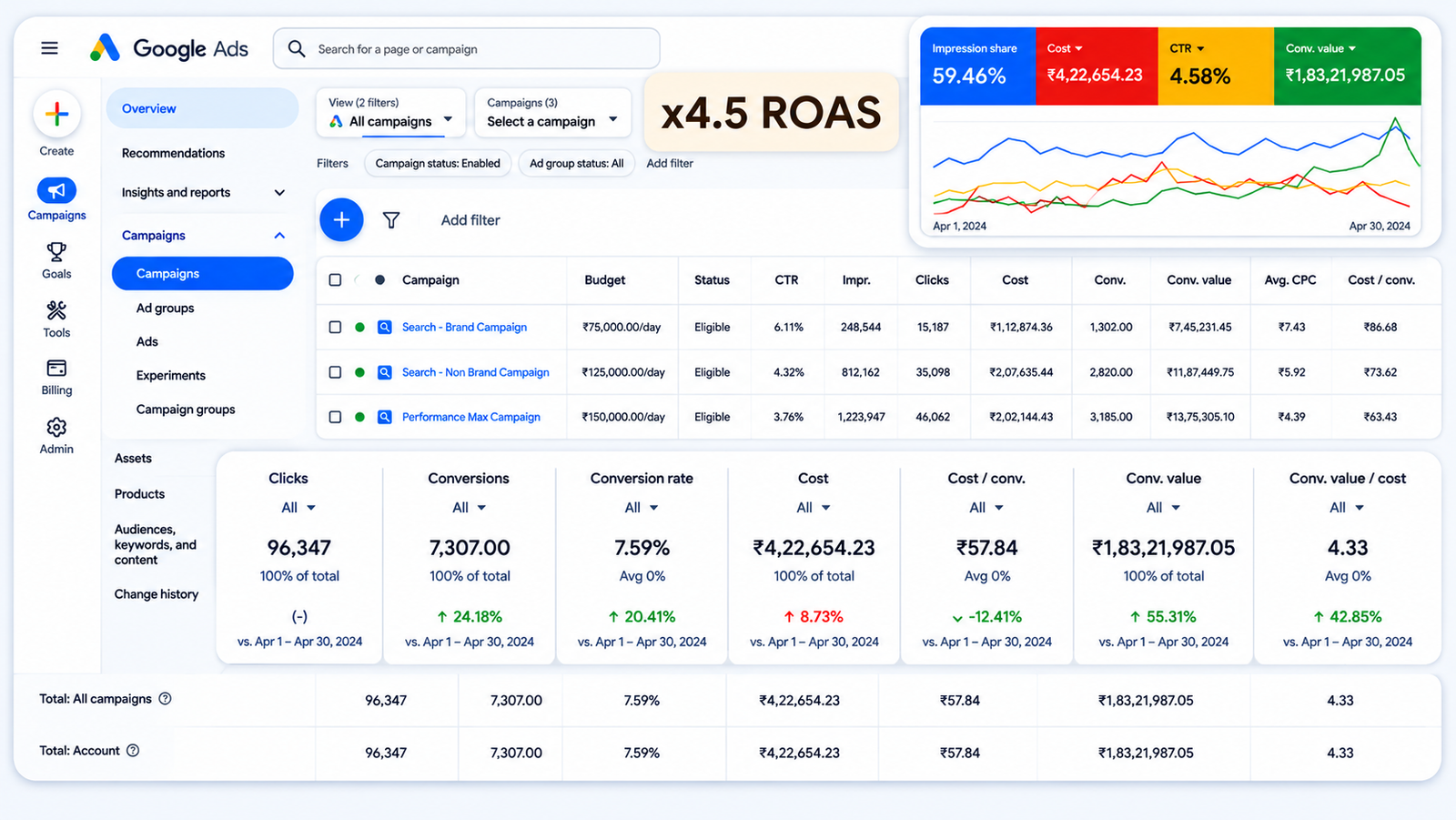
This account belongs to a dermatologist client. It combined Search campaigns for high-intent treatment queries with Performance Max for wider reach, and every conversion was tracked so decisions were made from evidence. The result was steady volume at a cost per conversion that stayed sensible as the account grew.
Every business is different, and past performance is never a guarantee of future results. What these numbers show is what proper structure, tracking and patient optimisation can do. Your campaign will have its own numbers, and we will build it around your market, your offer and your goals.
Real reviews from our Google Business Profile — tap "View All Reviews" to read them on Google directly.
Needed a simple website so local customers could find her business details, services and contact info. WebVengers kept it simple instead of overloading it with extras, and delivered exactly what she wanted in about 4–5 days.
"The team was friendly and listened to all my requirements before starting the website. Whenever I asked for any correction, they understood it and made the changes. The website is responsive and looks good on both mobile and desktop."
Wanted something simple, modern and professional. WebVengers understood the requirements and suggested good ideas, communication stayed smooth throughout, and changes were easy to request. The final website looks professional and gives a good impression to customers.
"I got my website developed from Webvengers and overall my experience was very good. They understood what I wanted and explained everything in a simple way. The website was looking clean, professional and easy to use."
Before starting the work, the team properly understood the business and what type of website was needed. The design came out simple but professional, and the site worked properly on mobile too. Supportive team, easy to communicate with, good service at a reasonable price.
Every one of our reviews so far is 5 stars, and we reply to each one personally.
View All ReviewsAds get the visit. Tracking tells you what the visit did. The landing page and lead quality decide whether it was worth paying for.
Without tracking, a Google Ads account is a car with no dashboard. You can hear the engine, but you cannot tell how fast you are going or how much fuel is left. We set up tracking around the actions that matter to your business, such as form submissions, phone calls, WhatsApp clicks, purchases and bookings, and we test each one before launch.
Once real conversion data flows in, the questions become far more useful. Instead of asking which campaign got the most clicks, you can ask which campaign brought qualified enquiries, which keywords contributed to revenue and which locations cost too much for what they return. Smart bidding also depends on this data. Feed it accurate conversions and it learns what a good customer looks like.
One hundred enquiries sounds wonderful until you learn that seventy are irrelevant, twenty are price shoppers and only ten are genuine. That is why we ask for feedback from your team about which leads were good. When we can see which enquiries closed, we can steer budget towards the searches, locations and messages that produce them, and we can import offline results back into Google Ads where setup allows.
Imagine someone searches for your service, clicks your ad and lands on a page that loads slowly, has no clear offer and hides the phone number. The money is already spent, and the visitor is already gone. The landing page has to continue the promise made by the ad and make the next step obvious.
If your existing page is holding the campaign back, we will say so plainly. Our own landing page service starts at ₹2,000 and is delivered in a day, and a full website starts at ₹8,000 with delivery in three days. Many clients find that fixing the page raises results more than increasing the ad budget would have.
There are three common ways to run Google Ads. Each can work, and each comes with trade-offs worth knowing before you decide.
An in-house specialist knows your business every single day, but a full-time hire means a salary, tools and training, and one person only brings the experience they personally have. It tends to make sense once your ad budget and team are already large.
Freelancers can be affordable, flexible and, at their best, excellent. The risk is depth and availability. When a freelancer is busy or unwell your campaign waits, and tracking, landing pages and creative often sit outside what they offer.
A team brings experience across industries, cover when someone is away and connected services such as websites, SEO and Meta Ads. The thing to check is whether you get real access to the people working on your account.
Where does WebVengers fit? We aim to give you the depth of a team at a cost that suits growing businesses. Our Google Ads management starts at ₹7,000 per month, which is a small fraction of what a full-time specialist would cost, and you also get websites, landing pages, SEO and Meta Ads from the same place when you need them.
You keep ownership of your Google Ads account and your data, you see every rupee of spend, and you can speak directly to the people doing the work. That mix of transparency and hands-on attention is what our Google Ads services and paid advertising services are built to deliver.
Each industry searches, compares and buys differently. Here is how we think about the ones we work with most, along with our related website work.
Buyers search by project, locality and budget. We target those exact phrases, filter out casual browsers, and send enquiries to a fast page. See our real estate websites.
Patients search by symptom, treatment and city, often urgently. Careful targeting and policy-aware ads protect trust. See our hospital websites.
Treatment-specific searches such as acne, hair fall and laser carry strong intent. This is the category behind our dashboard results. See our dermatologist websites.
“Dentist near me” and treatment-based searches reward tight location targeting and clear appointment buttons. See our dental websites.
People compare looks, prices and reviews before booking. Visual proof and easy WhatsApp booking help campaigns convert. See our salon websites.
Search ads capture “near me” hunger, while local targeting and timing keep spend where footfall is possible. See our restaurant websites.
Admissions run in seasons, so we plan budgets around enquiry windows and course-specific keywords. See our coaching websites.
Trial offers and joining deals work well when the ad promises one clear next step. See our fitness websites.
E-commerce, manufacturing, education, finance, travel and B2B all run well on Google when the setup fits. Tell us about your business and we will map it out.
Talk to UsAfter years of managing real budgets, the same six mistakes keep showing up. Here is how our Google Ads services avoid each of them.
A low cost per click looks wonderful until you discover nobody is buying. We judge every keyword by what it costs to get an enquiry or a sale, not by how cheap the click is.
Without negative keywords, your budget drifts to job seekers, students and free-advice hunters. We build negative lists from day one and extend them from real search terms.
A homepage tries to say everything to everyone. A matching landing page says the one thing the searcher wants. We pair each campaign with the page that fits its intent.
If you cannot see which clicks became customers, you are guessing. We set up and test tracking before launch, and we flag any conversion that looks too good to be true.
Spending five times more on a campaign that is not working only loses money faster. We fix the structure, offer and page first, then scale what the numbers justify.
Automated bidding needs time to learn, and constant edits reset that learning. We make deliberate changes, give them room to work, and judge them over a sensible window.
Think of Google Ads as renting attention and SEO as owning it. Ads switch on quickly and stop the moment the budget does. Organic visibility builds slowly but keeps working. The strongest plans use the speed of paid search to learn what customers want, then use that knowledge to build content that earns the same visitors for free over time. Our SEO services are designed to sit alongside our Google Ads management for exactly this reason.
Search is also changing shape. People now ask questions in full sentences, speak to voice assistants and get summaries from AI tools before they ever see a list of links. Two newer disciplines have grown around that shift, and they are worth understanding even if you only run ads today.
Answer Engine Optimization is the practice of structuring a page so that search engines and voice assistants can lift a clear answer straight from it. That means a direct answer near the top, honest headings written as real questions, short definitions and tidy structured data. The page you are reading is built that way on purpose.
Generative Engine Optimization focuses on making your business easy for AI tools such as ChatGPT, Gemini and Perplexity to understand and mention accurately. It rewards clear facts about who you are, what you offer and where you work, kept consistent across your website, Google Business Profile, directories and reviews. No one can promise that an AI tool will cite you, but a clear, consistent and well-evidenced presence gives you a far better chance than a vague one.
When we build or improve a page for your campaign, we write it for people first, and then structure it so machines can read it too. That includes question-style headings, concise answers, FAQ sections, schema markup, fast loading and consistent business details. The same page can then support your ads, your organic rankings and your presence in AI-driven answers, without you maintaining three separate versions.
If you want one team to handle the website, the ads and the search visibility together, our website development and Meta Ads teams work in the same room as the Google Ads team, so nothing falls between the cracks.
Plenty of agencies sell paid advertising services. Here is what we do differently.
We have been running Google Ads for several years across clinics, real estate, e-commerce, recruitment and more. That experience shows up in the mistakes we avoid before they cost you money.
We start from your margins, your customer value and your sales process, then build campaigns to fit. The dashboard is a tool, not the goal.
If Google Ads is not the right channel yet, or your website needs work first, we will say so rather than take your budget and hope.
Because we also build the pages your ads land on, we can fix conversion problems directly instead of sending you to another vendor.
A management fee of ₹7,000 per month, with your ad budget paid straight to Google. You always know what you are paying for and where your money goes.
We are based in Meerut and work with businesses across India. Everything happens online and over WhatsApp, so location never slows a project.
We run Google Ads for businesses in Delhi NCR, Mumbai, Jaipur, Lucknow, Pune, Ahmedabad and across India, as well as for local companies in and around Meerut. Searchers in different cities behave differently, so we build location groups around real demand instead of treating India as one block. A local service business might target a single city and its surrounding areas, while a national brand might group metros, tier-two and tier-three markets separately and judge each on its own results.
If you are looking for a Google Ads expert near you, the useful question is not just where the agency sits on the map. It is whether the agency understands your market, your customer and your numbers. Choose your city below to see how we work with businesses there.
Straight answers to the questions we hear most often about Google Ads services, pricing and results.
A Google Ads agency plans, builds and manages your paid campaigns on Google. That includes keyword research, ad writing, conversion tracking, bidding, budget control, search-term cleaning, landing page feedback and reporting. The agency’s job is to turn your ad spend into enquiries and sales, not just clicks.
There is no single price. Google Ads has two costs: your ad spend, which is paid to Google, and the agency’s management fee. Ad spend depends on your industry, city, competition and goals. At WebVengers, management starts at ₹7,000 per month, and you decide the ad budget separately.
Our Google Ads management fee starts at ₹7,000 per month. This covers strategy, setup, tracking, optimisation and reporting. Your advertising budget is not included, because it is paid directly to Google from your own account, so you can see exactly where every rupee goes.
No. Your ad budget goes straight to Google and is billed in your own Google Ads account. Our ₹7,000 monthly charge is for the management work. Keeping the two separate means you are never charged a hidden markup on your advertising spend.
Google does not set a strict minimum, but the practical minimum depends on your market. As a rough planning guide, many local service businesses start testing with ₹10,000 to ₹30,000 per month in ad spend, while competitive or national categories need more. We help you set a budget based on your customer value.
Enquiries can begin within days of launch, because Search ads appear as soon as they are approved. Performance usually becomes more stable over the first four to eight weeks, as search terms are cleaned up and bidding strategies learn. Judge a campaign over weeks, not hours.
They are the same platform. Google renamed AdWords to Google Ads in 2018. The auction, the campaign types and the way you pay all work the same way, so a Google AdWords specialist and a Google Ads expert are doing the same job.
Performance Max is a goal-based campaign that serves your ads across Google’s channels, including Search, YouTube, Display, Discover, Gmail and Maps. It works best when your conversion tracking is accurate and you have good creative assets. We usually add it after a Search campaign has proven what a real conversion looks like.
Search campaigns show text ads when someone types a matching keyword, and you control the ad copy. Shopping campaigns show product images, prices and store names, and they are driven by a product feed in Google Merchant Center. Search suits services and leads, while Shopping suits stores with a product catalogue.
Yes. We manage YouTube video campaigns for awareness and consideration, and app campaigns that aim at installs and in-app actions such as sign-ups or purchases. Both depend on clear goals and proper tracking, so we agree the success measure before launch.
No honest agency can. Results depend on your market, offer, website, pricing and competition. What we can commit to is proper setup, accurate tracking, steady optimisation and clear reporting. We share real campaign data so you can judge our work on evidence.
Yes, you need a page that can turn clicks into enquiries. If your current page is weak, we can build a landing page from ₹2,000 in one day or a full website from ₹8,000 in three days, designed to match your campaigns.
Yes. We are based in Meerut and run Google Ads for businesses across India, including Delhi NCR, Mumbai, Jaipur, Lucknow, Pune and Ahmedabad. Everything is handled online, so your location does not slow anything down.
Yes. We begin with an audit of your account structure, search terms, tracking and spend, and then tell you what to keep, fix or rebuild. Your account stays yours throughout, and you keep full access.
You do. We work inside an account that belongs to your business, and payments are made directly to Google. If we ever part ways, your campaigns, history and data remain with you.
Pay per click advertising gives you fast visibility, and you pay each time someone clicks. SEO takes longer, but organic visits do not cost per click. Many businesses use paid search for quick enquiries and SEO to build lasting visibility.
Look past the price. Ask whether the agency will set up conversion tracking, review search terms, explain where your money goes, look at lead quality and give you account ownership. A good Google Ads agency talks about your business numbers, not just impressions and clicks.
Get a free Google Ads audit and an honest view on budget, campaign types and what to expect.